Chapter 04
Courage without violence
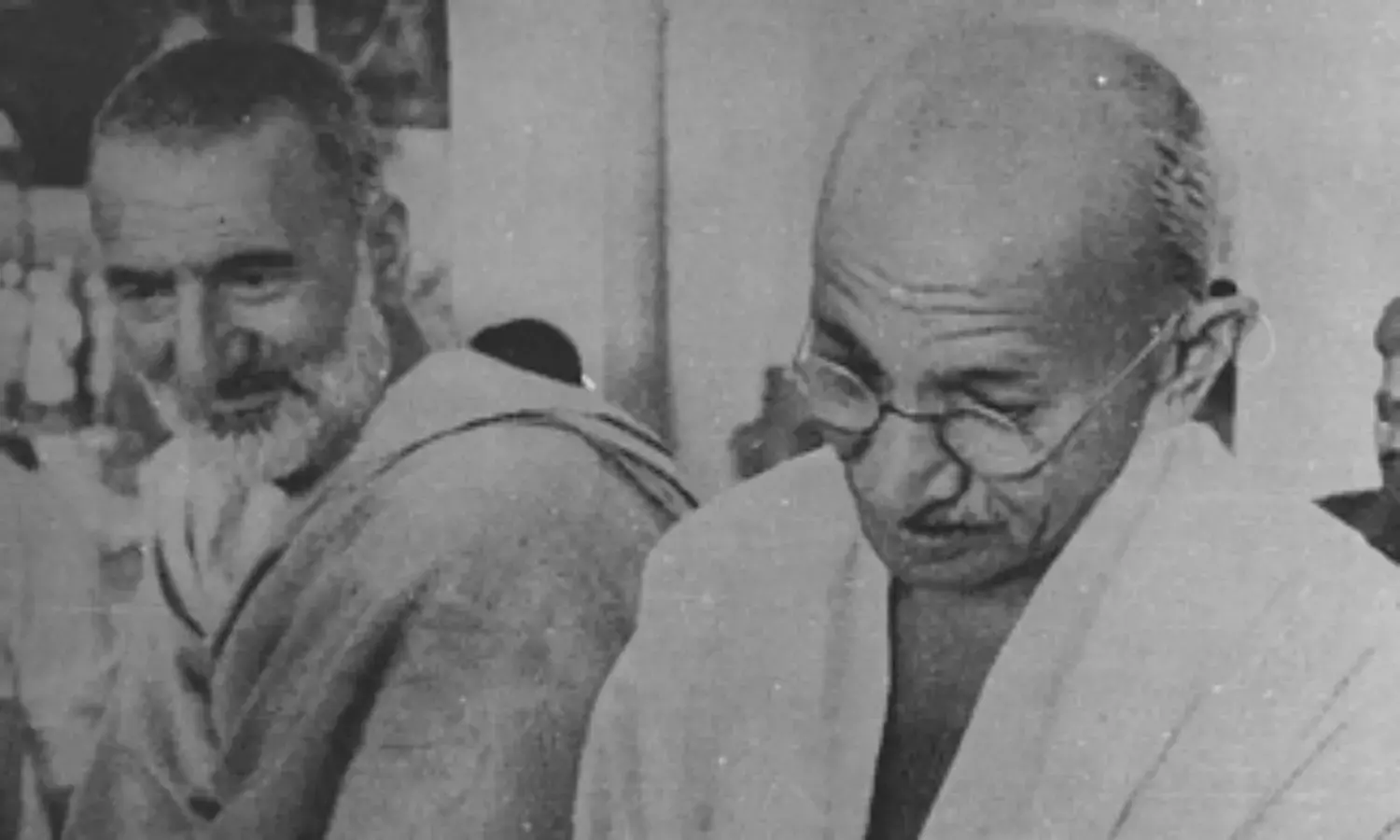
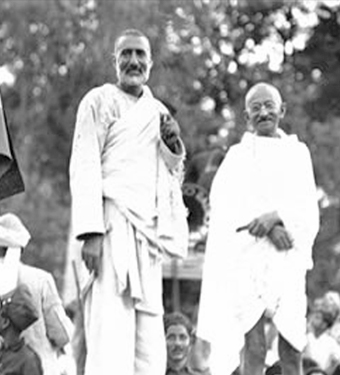
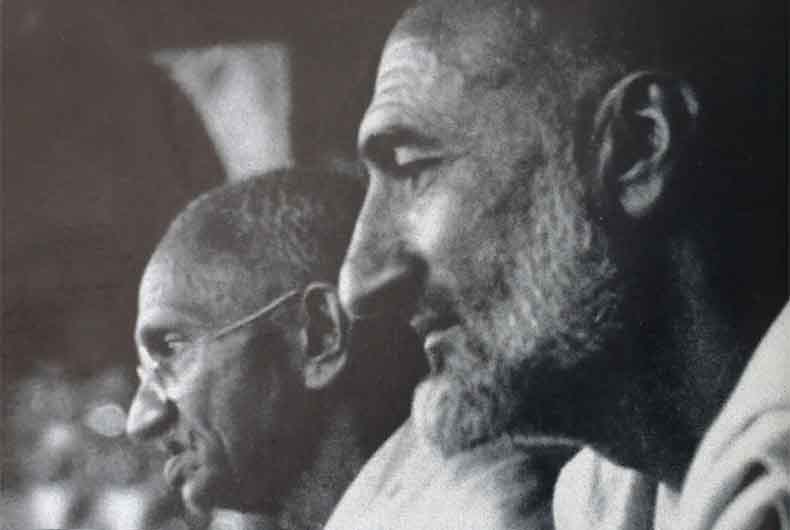
The friendship between Bacha Khan and Mahatma Gandhi is the most photographed relationship of his public life. It is also the most misunderstood — because the epithet the newspapers gave him, Frontier Gandhi, quietly implies that one man's ideas were a copy of the other's.
The relationship
Two men who arrived at the same discipline by different roads
Ghaffar Khan's nonviolence has a documented history that runs for years before the two men were working together. His campaign against the blood feud began in the 1910s; the argument that a Pashtun should absorb an injury rather than avenge it was being made in Hashtnagar villages long before it was being made to a colonial government. When the Khudai Khidmatgar was founded in 1929 and affiliated with the Congress in 1931, two nonviolent movements aligned. One was not born from the other.
What the alliance did produce was a genuine and, by all accounts, close friendship. Ghaffar Khan attended Congress sessions from the late 1920s and sat on the Congress Working Committee for years. When he was externed from the Frontier in the mid-1930s he spent that period in central India, near Gandhi at Wardha. Gandhi in turn travelled to the North-West Frontier Province in the late 1930s and went through Khudai Khidmatgar villages — for a Gujarati Hindu leader to tour the Pashtun frontier as a guest of an unarmed Muslim volunteer corps was, in the political atmosphere of that decade, a remarkable thing to be able to do.
Gandhi's interest in the Frontier was not only political. The Khudai Khidmatgar were, in terms of sheer numbers holding to nonviolent discipline under sustained violence, the most impressive practical demonstration of his own doctrine anywhere in India — and they were doing it in the province that the rest of the subcontinent regarded as the most warlike. That fact was useful to him, and he said so.
The name Frontier Gandhi — Sarhadi Gandhi — belongs to the press and the public, not to either man. It is a useful shorthand and a misleading one. Used carefully it says: here is another leader of a mass nonviolent movement. Used carelessly it says: here is a regional imitation. The second reading is wrong, and the record does not support it.
Comparison
Shared, and not shared
They were allies and friends who agreed on the central question. They were not the same thinker, and flattening them into one figure loses what is most interesting about both.
Shared — the core commitment
Both held that nonviolence was a moral position rather than a tactical calculation, and that it therefore could not be abandoned when it became inconvenient. Both required it of mass movements, not just of individuals, and both organised training and discipline to make that possible.
Distinct — where the authority came from
Gandhi drew on ahimsa in the Hindu, Jain and Buddhist traditions, read alongside Tolstoy, Ruskin and the Sermon on the Mount. Ghaffar Khan located his authority within Islam, and specifically in the Prophet's years of endurance at Mecca. He was explicit that he was not adopting a foreign creed.
Shared — constructive work
Neither treated resistance as sufficient on its own. Gandhi's constructive programme — spinning, sanitation, village industry, literacy — has a close counterpart in the Khudai Khidmatgar's daily duties of teaching, street cleaning, road building and mediation.
Distinct — the society being addressed
Gandhi's problem was to hold nonviolence across an enormous, plural subcontinent. Ghaffar Khan's was narrower and in some ways harder: to persuade one society, bound by an explicit obligation of revenge, that not retaliating was the braver course.
Shared — refusal of office
Neither took government office in independent India or Pakistan. Ghaffar Khan declined the Congress presidency in 1931 and refused a ministry in Pakistan in 1958, after his brother's assassination.
Distinct — what 1947 did to each
Gandhi was assassinated in January 1948, months after independence. Ghaffar Khan lived a further forty years on the other side of the new border, in and out of the prisons of the state Partition had placed him in. Their legacies were shaped by very different afterlives.
The idea itself
Nonviolence as a strategy and as an ethic
“He believed in peace” is not a description of anything. It is worth setting out what the position actually involved, because it was demanding and specific.
As moral conviction. Ghaffar Khan grounded nonviolence in religious obligation, not in expected results. This matters practically: a discipline that rests on outcomes collapses the first time it fails to produce them, and his did not collapse — not in 1930, not through the bans and mass arrests of the 1930s, and not after 1947 when it had visibly failed to secure what its members wanted.
As discipline. The oath, the ranks, the drill, the uniform and the jirga structure existed to make restraint reliable under provocation. Individual saintliness does not scale; organisation does. A hundred thousand people do not stay nonviolent because they are all exceptional. They stay nonviolent because they are trained, supervised, publicly identified and answerable to each other.
As collective action. He was organising a mass movement, not counselling individuals. That changes what nonviolence is for: it becomes a way of withdrawing cooperation at scale, which a colonial administration depends on absolutely, while denying that administration the justification that armed resistance would have supplied.
As civil disobedience. Its concrete forms were the ordinary repertoire of the Indian movement — the Salt Satyagraha, boycotts, refusal to obey specific orders, filling the jails deliberately. What was unusual in the Frontier was who was doing it and where, under a legal regime with fewer restraints on the administration than anywhere else in British India.
As social reform. And underneath all of it, the thing he never separated it from: schools, literacy, the end of the feud, the education of women. He did not treat these as preparation for the political struggle. He treated them as the same struggle.
The four-part framing above is this site's analytical summary of his position, offered to make it legible to a modern reader. It is drawn from the historical record but it is not a scheme Ghaffar Khan himself set out in these terms.
In his own words
The weapon
of the Prophet
“I am going to give you such a weapon that the police and the army will not be able to stand against it. It is the weapon of the Prophet, but you are not aware of it. That weapon is patience and righteousness. No power on earth can stand against it.”Khan Abdul Ghaffar Khan, to the Khudai Khidmatgar Widely reproduced in the scholarship on the movement; the standard published source is Eknath Easwaran, Nonviolent Soldier of Islam: Badshah Khan, a Man to Match His Mountains (first published 1984).
Read it as recruitment, which is what it was. He is speaking to men for whom the word weapon is not a metaphor, and he keeps it — then substitutes the content. The claim is not that fighting is wrong and they should be gentler. The claim is that he has something stronger, that it is theirs already, and that they have simply forgotten it.
That rhetorical move is the whole of his method in one sentence: nonviolence offered not as a renunciation of Pashtun honour but as its more demanding form.
On quotations. Only quotations that can be traced to a named published source appear on this site, and the source is given each time. Sayings that circulate widely online without traceable attribution are not reproduced here, however apt they sound.